Traditional Bloom Embroidery
A Folk-Inspired Flower That Commands Attention at Any Craft Fair
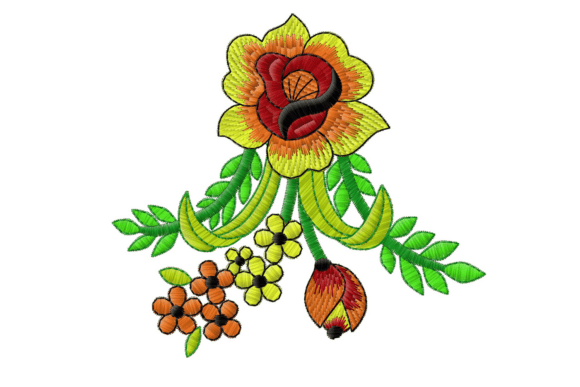
As an embroidery designer who’s set up over 80 craft fair booths—and watched thousands of shoppers pause, point, and reach for stitched goods—my first impression of Traditional Bloom Embroidery is immediate: it’s warm, radiant, and unmistakably handmade. This isn’t a minimalist line drawing or a trendy abstract bloom. It’s a folk-inspired composition rooted in tradition but bursting with contemporary energy—red, orange, and yellow petals glow against vibrant green leaves and delicate secondary blossoms. The stylized shape gives it rhythm without rigidity, making it feel both timeless and fresh. In a sea of neutral linen totes and monochrome patches, Traditional Bloom Embroidery stands out as bold yet approachable—farmhouse-friendly but not rustic-cliché, decorative but never fussy.
Where Traditional Bloom Embroidery Shines On Real Products
This design thrives where handmade charm meets everyday utility. On a tote bag design, it reads clearly from six feet away—especially when placed front-and-center on natural canvas or oat-colored cotton. As apron embroidery, it anchors the chest pocket area beautifully, adding personality without overwhelming the wearer’s movement. For tea towel embroidery, the warm tones pop against white, ivory, or sage-dyed linen, and the leafy elements echo kitchen garden motifs shoppers love. As an embroidered patch, it scales down elegantly to 2.5–3 inches—ideal for denim jackets, market bags, or kids’ backpacks. On pillow covers and small fabric pouches, Traditional Bloom Embroidery delivers giftable luxury: it feels intentional, crafted, and full of story.
It also works powerfully as a commercial embroidery asset. Because it’s a single-flower motif, it’s easy to pair with coordinating designs (think berry sprigs or honeybees) for cohesive booth displays or curated Etsy shop collections. Unlike dense bouquets or text-heavy layouts, Traditional Bloom Embroidery doesn’t compete with product texture—it complements it. That’s critical on textured towels or looped terry cloth, where overly fine details vanish.
What Makes This Design Sell—And What Requires Careful Handling
Traditional Bloom Embroidery succeeds because it’s instantly legible. At a glance, customers recognize “flower,” “warmth,” and “handmade.” That clarity drives impulse buys—especially for craft fair product shoppers scanning tables quickly. Its balanced proportions allow flexibility: it holds impact at 4 inches (on a cap front) and expands gracefully to 7 inches (on a large tote or pillow cover). As a digital embroidery file, it’s likely well-suited for batch production—clean outlines, logical fill areas, and no micro-detail traps like tiny stamens or thread-thin stems that snag or blur.
That said, thoughtful execution matters. If the original machine embroidery design includes tightly packed satin stitches in the center blossom—or overlapping leaf veins—the stitch density could cause puckering on lightweight cotton or stiffening on soft knits. Always test on scrap fabric matching your final product’s weight and drape. On dark fabric, confirm that the red-orange-yellow thread colors retain luminosity; some warm tones dull on charcoal or navy unless paired with bright white underlay. And on curved surfaces—like structured caps or rounded pouch seams—verify that the design’s outer curves don’t distort during hooping.
Design Assets That Elevate Your Entire Booth
When you’re curating a weekend display, Traditional Bloom Embroidery does heavy lifting beyond the stitch. It strengthens brand consistency: use it across three product types (e.g., tea towel, apron, patch), and shoppers begin to associate your booth with joyful, grounded craftsmanship. It boosts booth display strength—hang a pillow cover beside a folded tote and a framed printable mockup, and the repeated motif creates visual rhythm. For Etsy sellers, it photographs exceptionally well: natural light highlights the dimensional stitch play between petals and leaves, and the warm palette translates faithfully on screen. Pair it with earthy props—dried lavender, woven baskets, ceramic mugs—and your small shop product feels editorial-ready.
Practical Embroidery Designer Notes Before You Stitch
- Test before you commit: Run a sample on the exact fabric and stabilizer you’ll use for production. Note how leaves lie flat and whether small blossoms read cleanly.
- Check thread contrast: Warm tones can blend on peach or terracotta fabrics—add a subtle white outline or adjust underlay if needed.
- Review spacing and flow: Ensure petal edges don’t crowd adjacent seams or pockets, especially on aprons and pouches.
- Confirm hoop size compatibility: A stylized bloom may stretch wider than expected—measure the design’s bounding box before digitizing or purchasing.
- Inspect stitch density: High-density fills in the flower center may require medium-weight cutaway stabilizer on knits or lightweight weaves.
- Create at least one real mockup: A finished embroidered tote bag tells customers more than ten printed mockups ever could.
- Compare fabric colors: Print swatches of your base fabrics next to thread charts—what looks vibrant on screen may mute in person.
- Confirm commercial licensing: If selling finished products (not just the embroidery file), ensure your license permits commercial embroidery use—especially for resale on Etsy or at markets.
Why Traditional Bloom Embroidery Fits Right Into Your Handmade Product Line
In a market saturated with digital prints and laser-cut kits, Traditional Bloom Embroidery reaffirms the value of slow, tactile making. It doesn’t shout—it invites. Shoppers lean in to trace the curve of a petal with their finger. They ask, “Did you stitch all of these yourself?” That moment of connection is gold at a craft fair. As a Single Flowers design, it’s versatile enough for seasonal rotations (pair with berry motifs in fall, bees in summer) yet distinct enough to become a signature. Whether you’re launching your first handmade product line or expanding a decade-old boutique, Traditional Bloom Embroidery delivers warmth, recognition, and quiet confidence—exactly what handmade buyers are searching for.